Need Help!

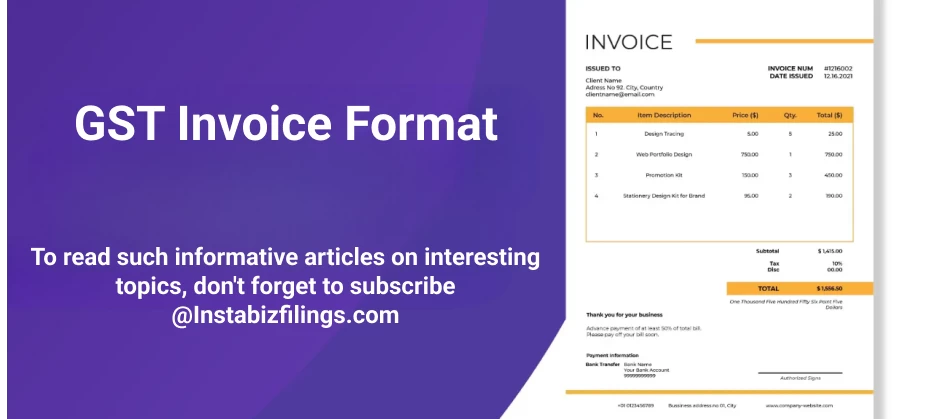
A GST invoice is a crucial document issued by a registered taxpayer under the Goods and Services Tax system. It serves as legal proof of supply and is essential for claiming Input Tax Credit (ITC). Understanding the correct GST invoice format ensures compliance and avoids penalties.
A GST invoice (also known as a tax invoice) is issued by a supplier to a buyer for goods or services supplied. It includes details such as value, tax charged (CGST, SGST, or IGST), and other required information as per GST laws.
Depending on the nature of supply, GST invoices are categorized as:
As per GST rules in India, a valid GST invoice must include the following details:
Name of the business
Address
Unique invoice number (not exceeding 16 characters)
Date of issue
Name of the customer
Billing address
Shipping address (if different)
GSTIN (if registered)
HSN code for goods
SAC code for services
Item name
Quantity
Unit price
Total value
Taxable value
CGST, SGST, IGST rates and amounts
Total tax amount
Required for interstate transactions
Signature (digital or physical) of supplier or authorized representative
Below is a standard GST invoice format:
--------------------------------------------------
TAX INVOICE
--------------------------------------------------
Supplier Name:
Address:
GSTIN:
Invoice No:
Invoice Date:
Recipient Name:
Address:
GSTIN:
--------------------------------------------------
Description | HSN | Qty | Rate | Amount
--------------------------------------------------
Product A | XXX | 10 | 100 | 1000
--------------------------------------------------
Taxable Value: ₹1000
CGST @ 9%: ₹90
SGST @ 9%: ₹90
Total Invoice Value: ₹1180
Place of Supply:
Authorized Signature
--------------------------------------------------
Invoice must be issued within 30 days of supply of services
For goods, invoice must be issued before or at the time of delivery
Maintain proper serial numbering system
Keep records for at least 6 years
E-invoicing is mandatory for businesses exceeding prescribed turnover limits
E-invoicing is applicable to businesses with turnover above a specified threshold. In this system:
Invoice is generated through the GST portal
Invoice Reference Number (IRN) is issued
QR code is included for verification
Ensures legal compliance
Helps claim Input Tax Credit (ITC)
Reduces chances of penalties
Improves business transparency
Simplifies accounting and audits
Missing GSTIN or incorrect details
Wrong tax calculation
Incorrect HSN/SAC codes
Duplicate invoice numbers
Not issuing invoice on time
A proper GST invoice format is essential for every registered business in India. It not only ensures compliance with GST laws but also facilitates smooth tax filing and credit claims. By including all mandatory components and following the prescribed format, businesses can avoid legal complications and maintain financial accuracy.
The information provided in this blog is purely for general informational purposes only. While every effort has been made to ensure the accuracy, reliability and completeness of the content presented, we make no representations or warranties of any kind, express or implied, for the same.
We expressly disclaim any and all liability for any loss, damage or injury arising from or in connection with the use of or reliance on this information. This includes, but is not limited to, any direct, indirect, incidental, consequential or punitive damage.
Further, we reserve the right to make changes to the content at any time without prior notice. For specific advice tailored to your situation, we request you to get in touch with us.