
Send an Enquiry
Enquiry Form
Call us now
Call Us Now
9136664394
9136664395
7304244849
c shape
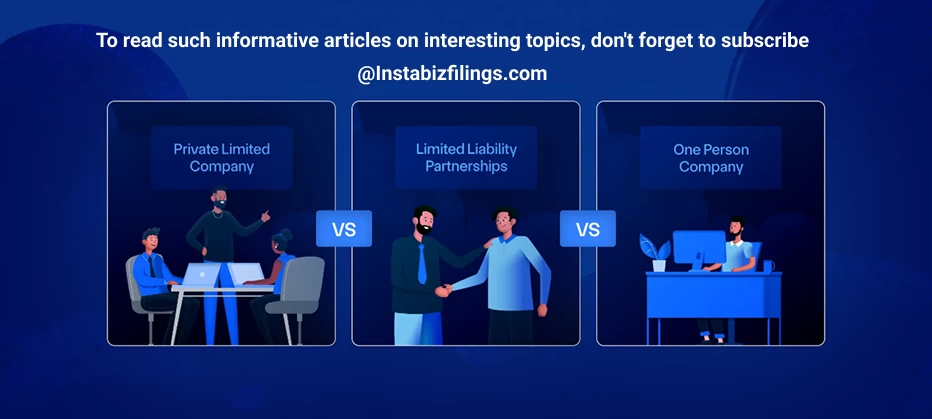
Private Limited Company Limited Liability Partnership One Person Company

Private Limited Company vs LLP vs OPC – Which Is Best?

December 25, 2025 by Team Instabizfilings

Private Limited Company vs LLP vs OPC – Which Is Best?

Private Limited Company (PLC)


What is a Private Limited Company?


A Private Limited Company is a business structure where the liability of its members (shareholders) is limited to the amount unpaid on their shares. This is one of the most common forms of business entities, especially for small and medium enterprises (SMEs). PLCs are governed by the Companies Act 2013 in India (or equivalent legislation in other countries).


Key Features:


  • Number of Members: A minimum of 2 and a maximum of 200 shareholders (excluding employees).

  • Legal Status: Separate legal entity distinct from its owners.

  • Ownership: Transfer of shares is restricted, i.e., cannot be freely traded on the stock exchange.

  • Liability: Shareholders' liability is limited to the unpaid amount of their shares.

  • Capital Requirement: No minimum capital requirement in India, but in some countries, there may be minimal capital requirements.


Advantages of PLC:


  • Limited Liability: Shareholders are only liable up to their unpaid share value, protecting personal assets.

  • Access to Funding: Easier to raise funds through the sale of shares, and many investors are more inclined to invest in private limited companies.

  • Perpetual Succession: The company continues to exist even if the owners or shareholders change.

  • Credibility: PLCs tend to have better credibility with financial institutions, investors, and clients due to their regulatory requirements.

  • Tax Benefits: Subject to corporate tax, but there are various exemptions, deductions, and benefits under different taxation regimes (e.g., MSME schemes).


Disadvantages of PLC:


  • Compliance and Regulation: Regular filings, audits, and adherence to corporate governance norms can be burdensome.

  • Higher Costs: Incorporation, ongoing compliance, and annual audits incur higher costs compared to LLPs or OPCs.

  • Restrictions on Share Transfer: Though ownership can change, it is subject to the approval of other shareholders, which can limit flexibility.


When to Choose PLC?


A PLC is ideal for businesses that need to raise significant capital, have multiple shareholders, and require a formalised structure. It’s also suited for companies planning to expand or raise funds from venture capitalists or investors.


Limited Liability Partnership (LLP)


What is an Limited Liability Partnership (LLP)?


An LLP is a business structure that combines the flexibility of a partnership with the limited liability feature of a company. It’s governed by the Limited Liability Partnership Act 2008 in India (or similar laws elsewhere).


Key Features


  • Number of Partners: At least 2 partners, no upper limit.

  • Legal Status: Separate legal entity distinct from its owners (partners).

  • Ownership: Partners have ownership based on their share of capital contribution.

  • Liability: Partners are not personally liable for the debts of the business beyond their agreed capital contribution.

  • Capital Requirement: No minimum capital requirement in India.


Advantages of LLP


  • Limited Liability: The personal property of the partners will be safe from the charges/bills of the ​‍​‌‍​‍‌​‍​‌‍​‍‌LLP.

  • Flexibility: The structure offers more flexibility in terms of management, decision-making, and profit-sharing compared to PLCs.

  • Taxation: LLPs are generally taxed at a lower rate than PLCs, with no dividend distribution tax (which applies to PLCs).

  • Fewer Compliance Requirements: LLPs face lower regulatory compliance compared to PLCs, making them ideal for smaller businesses or startups.


Disadvantages of LLP


  • No Access to Capital Markets: LLPs cannot raise funds through the issue of shares like PLCs.

  • Limited Recognition: While an LLP is recognised as a separate entity, it may not carry the same weight or credibility as a PLC for certain investors or clients.

  • Limited Scope for Expansion: Though LLPs can grow, their capacity to scale up may be constrained by the lack of access to external funding sources.


When to Choose LLP?


LLPs are ideal for small businesses, professionals (like law firms, accounting firms, etc.), or startups looking for a more flexible structure with limited compliance burdens. It’s also suitable for businesses where the partners want to have greater control over the operations and distribution of profits.


One Person Company (OPC)


What is an One Person Company (OPC)?


An OPC is a type of private company that is designed for entrepreneurs who want to operate a company with a single owner but still enjoy the benefits of limited liability. It’s a relatively new concept introduced under the Companies Act, 2013.


Key Features


  • Number of Members: Only 1 member is required (owner).

  • Legal Status: Separate legal entity.

  • Ownership: The sole owner holds 100% of the shares.

  • Liability: Liability is limited to the unpaid amount of shares.

  • Capital Requirement: Minimum paid-up capital of INR 1 lakh (subject to specific country laws).

  • Directors: At least 1 director, with a maximum of 15.


Advantages of OPC


  • Limited Liability: The owner's responsibility for the company's debts is limited to the amount of their shareholding; therefore, their personal assets are safeguarded.

  • Single Ownership: Perfect for entrepreneurs who want full control of their business without the need for partners.

  • Simplicity and Flexibility: Fewer regulatory requirements compared to PLCs, making it easier to manage.

  • Less Compliance: OPCs have simpler filing requirements than PLCs, making it an attractive option for solo entrepreneurs.


Disadvantages of OPC


  • No Access to External Funding: Like LLPs, OPCs cannot issue shares to raise capital, which can limit growth.

  • Limited Scalability: While an OPC can evolve into a Private Limited Company, the growth and ability to scale may be restricted by the absence of additional stakeholders.

  • Restrictive Regulations: An OPC can have only one shareholder, which limits its expansion potential. Also, there is a restriction on conversion to a Private Limited Company unless certain conditions are met.


When to Choose OPC?


OPCs are ideal for solo entrepreneurs or those looking to start a business without the complexities of having a partner. It is the best option for small-scale businesses, especially in the initial stages of a business venture.


Which Is Best?


The decision between a Private Limited Company, Limited Liability Partnership (LLP), or One Person Company (OPC) depends on various factors like your business goals, the scale of operations, funding needs, and regulatory preferences.


  • Best for Raising Capital : Private Limited Company – If you plan to raise significant capital, bring in investors, or scale rapidly, a Private Limited Company is the best option.
  • Best for Flexibility and Lower Compliance : LLP – If you want a flexible, easy-to-manage business structure with lower compliance requirements, an LLP is a great choice. It’s ideal for professionals, small businesses, or partnerships.
  • Best for Solo Entrepreneurs : OPC – If you're a solo entrepreneur who wants to have full control of the business with limited liability, an OPC offers the best of both worlds: simplicity and protection.


Future Trends in 2025


  • Digital Transformation: With more businesses going digital, the ease of maintaining regulatory filings and compliance might shift the preference towards LLPs and PLCs that have simpler tech integration processes.

  • Taxation: The push for more tax-friendly environments for smaller businesses might make LLPs and OPCs increasingly attractive as governments offer incentives for these structures.

  • Startup Ecosystem: If you’re a startup looking for external investment or venture capital, a Private Limited Company is still the most viable option due to the regulatory framework around fundraising.


Conclusion


  • A Private Limited Company is best for businesses with aspirations of scaling, attracting investors, or expanding.

  • Limited Liability Partnership is ideal for businesses that want the flexibility of a partnership but with limited liability, along with lower compliance burdens.

  • A one-person company is best suited for solo entrepreneurs who want the limited liability protection of a company but without the need for a partner.


Disclaimer


The information provided in this blog is purely for general informational purposes only. While every effort has been made to ensure the accuracy, reliability and completeness of the content presented, we make no representations or warranties of any kind, express or implied, for the same. 


We expressly disclaim any and all liability for any loss, damage or injury arising from or in connection with the use of or reliance on this information. This includes, but is not limited to, any direct, indirect, incidental, consequential or punitive damage.


Further, we reserve the right to make changes to the content at any time without prior notice. For specific advice tailored to your situation, we request you to get in touch with us.



Placeholder Image

Need more details? We can help! Talk to our experts now!

Start Your Business Registration – Talk to Our Experts Now!
what You Reading

Like What You're
Reading?

Get fresh monthly tips to start &
grow your Business.